End-to-end process · District heating connection

Lead-to-Activation

From first customer interest to start of supply: how process intelligence exposes rework, seasonal construction times and compliance risks in district heating connections – and turns them into prioritised measures.

What is Lead-to-Activation?

Lead-to-Activation is the end-to-end process from a newly created lead to an active service at the customer. For a district heating connection it covers sales and offer, the parallel coordination of civil works, materials and house connection, construction and commissioning, and finally the handover report, billing and start of supply. From the customer’s side it sounds simple – interest, offer, contract, construction, connection, heat. In reality it is one of the most complex processes in the energy sector.

Note: the figures shown come from a synthetic demonstration dataset. They illustrate analysis paths and methodological relationships and are not production figures of any customer.

At a glance

13%

Offers reworked

154 of 1,208 cases between offer preparation and sending

+20 days

Construction in winter

A recurring seasonal pattern from November to March

121

Supply before handover

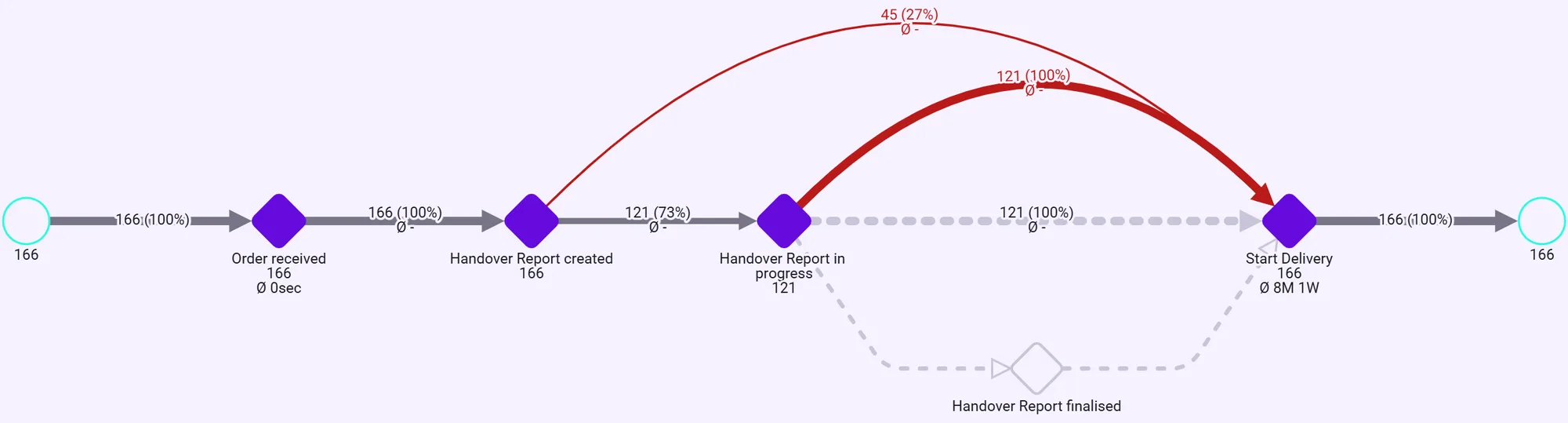
connections start supply before the handover report is finalised; 45 skip it entirely

119

Missing permits

of 1,208 cases lack a timely official permit before construction starts

The process in four phases

Even before the order, information sits in different systems and objects. After the order the flow branches into parallel strands that have to be joined again before construction, commissioning, billing and start of supply.

Phase 1

Sales: from lead to order

A lead is created and qualified. Qualified leads get a technical calculation, on which the offer is prepared, sent and finally signed as a contract.

Business objects

  • Lead
  • Calculation
  • Offer
  • Contract
  • Order
  1. Lead created
  2. Lead qualified
  3. Technical calculation completed
  4. Offer prepared
  5. Offer sent
  6. Contract signed
  7. Order received

Guiding question

How often does an offer go back for rework – and why?

Phase 2

Trade coordination: parallel strands up to construction start

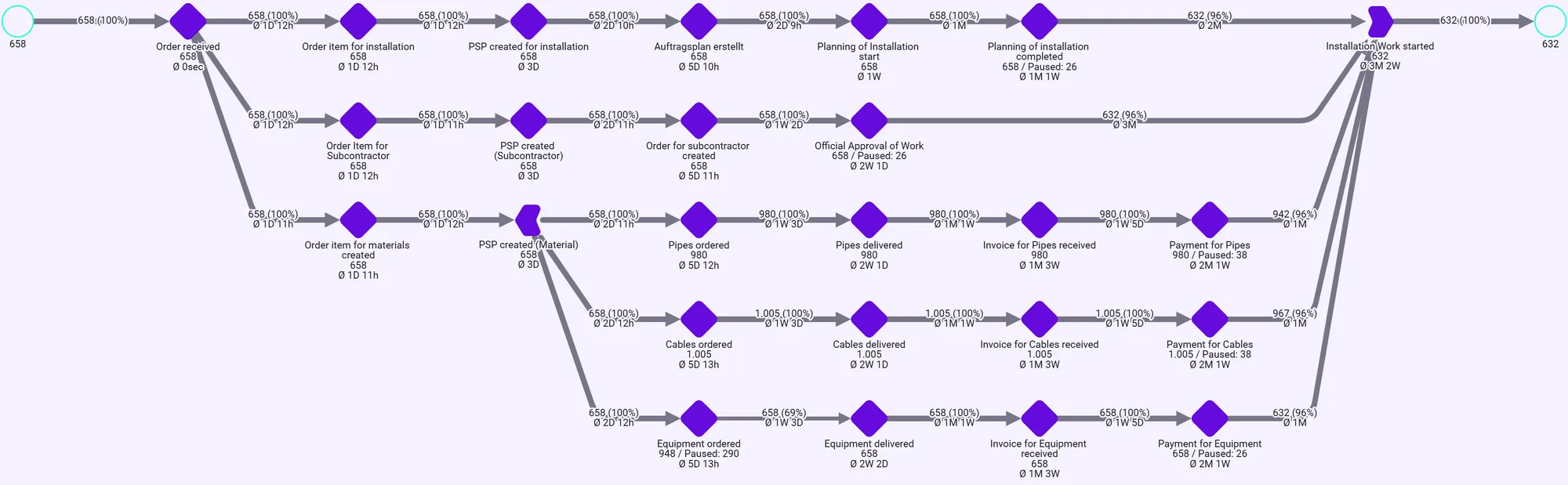
After the order several strands run at once. They have different durations, objects and cardinalities – a single connection can create several purchase orders, deliveries and invoices.

Business objects

  • Order item
  • WBS element
  • Purchase order
  • Delivery
  • Invoice
  • Permit

House connection & planning

  1. 1Order item for installation
  2. 2WBS element
  3. 3Work plan
  4. 4Installation planning

Subcontracting & civil works

  1. 1Order item for subcontractor
  2. 2Subcontractor order
  3. 3Official permit

Materials: pipes, cables, equipment

  1. 1Ordered
  2. 2Delivered
  3. 3Invoice received
  4. 4Payment

Guiding question

Which prerequisite is holding back the shared next step – the start of construction?

Phase 3

Construction & commissioning

Construction only starts once all strands are joined. The end of construction is followed by acceptance and technical commissioning. When several connections are bundled into one civil-works job, the cases also depend on each other.

Business objects

  • Construction job
  • Connection
  • Acceptance
  1. Construction started
  2. Construction completed
  3. Acceptance
  4. Commissioning

Guiding question

Which part of construction slows down, from when, by how much – and does it repeat?

Phase 4

Handover, billing & start of supply

The handover report has to reach certain states before supply starts. Commercial finalisation with billing runs in parallel.

Business objects

  • Handover report
  • Invoice
  • Supply contract
  1. Handover report created
  2. Handover report in progress
  3. Handover report finalised
  4. Billing
  5. Start of supply

Guiding question

Were all prerequisites met at the moment supply started?

A business case is not the same as a single business object. What matters is that the analysis keeps objects and their relationships instead of aggregating them early into a flat event log – only then can every finding be traced back to the affected orders, purchase orders or reports.

Four findings along the process

The following patterns were uncovered with Noreja. Each answers a concrete business question – and moves it from “What happened?” to “Why did it happen and what follows from it?”.

Finding 1 · Sales

One offer in eight goes back for rework

Instead of counting every repetition as a new process variant, it is interpreted as rework: a recurring error pattern that delays contract signature and ties up sales capacity.

The same pattern shows up again later: in billing, about 106 of 1,089 cases show a later correction. Rework is therefore not an issue of one department but a cross-process theme.

154 / 1,208

reworks between “Offer prepared” and “Offer sent” (≈ 13%)

Instead of “Which variant is this?”

the analysis asks: “Which error pattern is this, why does it occur and what is its impact?”

Sales process graph for a district heating connection: loop from “Offer sent” back to “Offer prepared” highlighted as rework
Rework in the offer process: loops between “Offer prepared” and “Offer sent”.

Finding 2 · Construction

Construction systematically slows down in winter

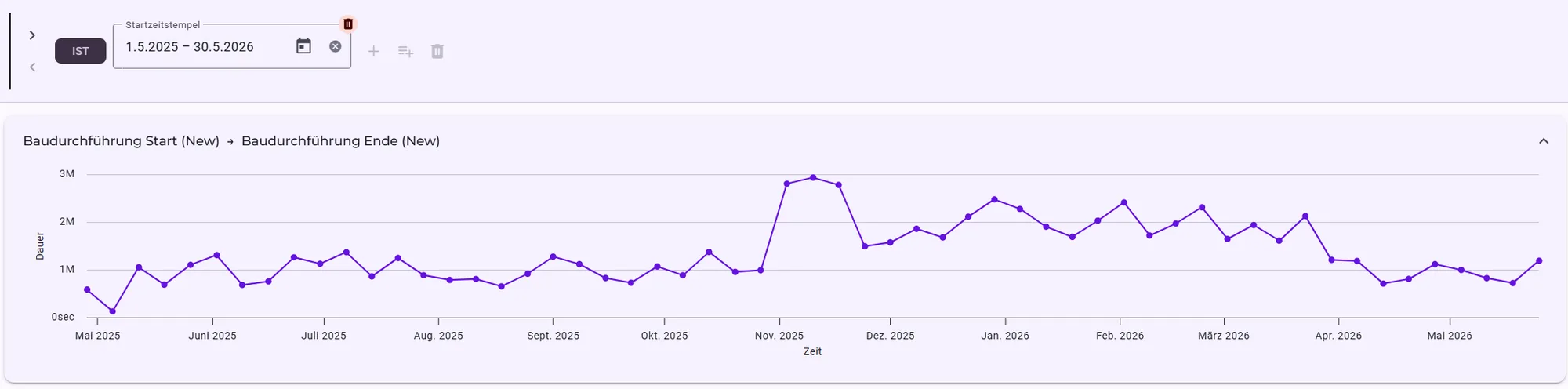
A long lead time in a single case says little. So the same activity is looked at across all process instances and turned into a time series: from November the duration of construction rises noticeably, stays high through the winter and drops again from April.

The time series stays connected to the process structure and can be traced back to concrete periods, cases and objects.

≈ 20 days

longer construction in the winter months

Instead of “Is the process slower in winter?”

the analysis asks: “Which specific part slows down, from when, by how much – and does it repeat?”

Time series of construction duration from start to end, May 2025 to May 2026, rising sharply from November
Time series of construction (start → end): duration rises over the winter months.

Finding 3 · Compliance

Supply starts before the handover report is finalised

The handover report has to reach certain states before supply starts. The business question therefore matters more than the plain sequence of events.

For field processes one distinction is crucial: a late timestamp in the ERP – caused by missing connectivity or later synchronisation – does not mean the real process was late. Process errors and data errors look the same in an event log but need completely different measures.

121 · 45

connections start supply before finalisation (≈ 11%) · finalisation skipped entirely (4.1%)

Instead of “In which order did the events happen?”

the analysis asks: “Were all prerequisites met when supply started?”

Handover report process graph: paths from “Handover Report created” and “in progress” straight to “Start Delivery”, bypassing “finalised”
Compliance view of handover reports: not every connection reaches the expected states before supply starts.

Finding 4 · Trade coordination

Construction start depends on several prerequisites at once

No single activity decides when construction can start – several prerequisites have to be met together. 393 units had to be sourced from another supplier because the first could not deliver; 119 of 1,208 cases lack a timely official permit; and in some cases construction does not start despite completed technical work because a commercial prerequisite such as the customer’s down payment is missing.

That is the core of causal process logic: not only knowing what happened, but which prerequisite is missing for the next step to happen.

393 · 119

units sourced from a second supplier · cases without a timely permit

Instead of “Which activity takes longest?”

the analysis asks: “Which prerequisite is holding back the shared next step?”

Process graph of parallel trades before construction start: installation, subcontracting and material strands for pipes, cables and equipment
Parallel trades before construction start: subcontracting, house connection and material strands run at the same time.

Where the biggest time levers are

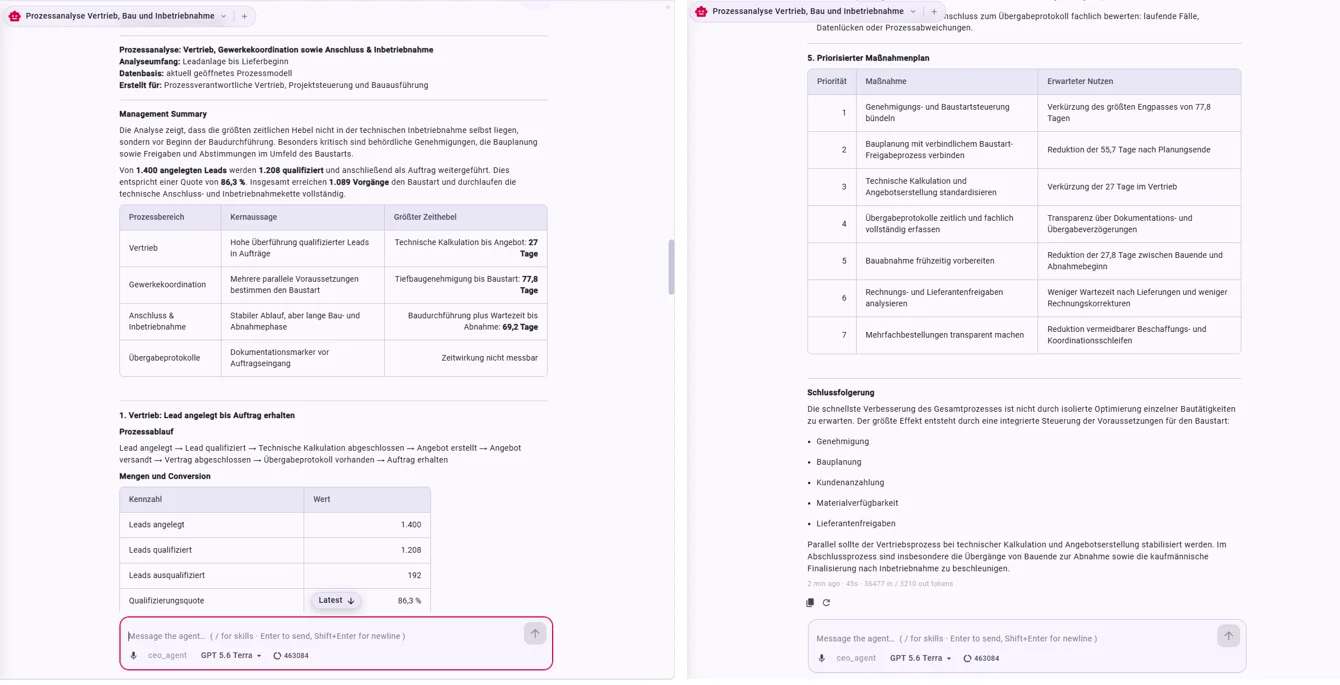
The AI assistant Minerva summarises the process areas and names the biggest time levers. The process manager starts with a business question instead of first choosing a view, filter and visualisation.

Process areaKey statementBiggest time leverDuration
SalesHigh conversion of qualified leads into ordersTechnical calculation to offer27 days
Trade coordinationSeveral parallel prerequisites decide construction startCivil-works permit to construction start77.8 days
Connection & commissioningStable flow, but long construction and acceptance phaseConstruction plus wait until acceptance69.2 days
Handover reportsDocumentation marker before order receiptTime impact not measurable
Minerva management summary of the sales, construction and commissioning analysis with a table of time levers and a prioritised action plan
Minerva summarises process areas and identifies the biggest time levers.

From finding to prioritised measure

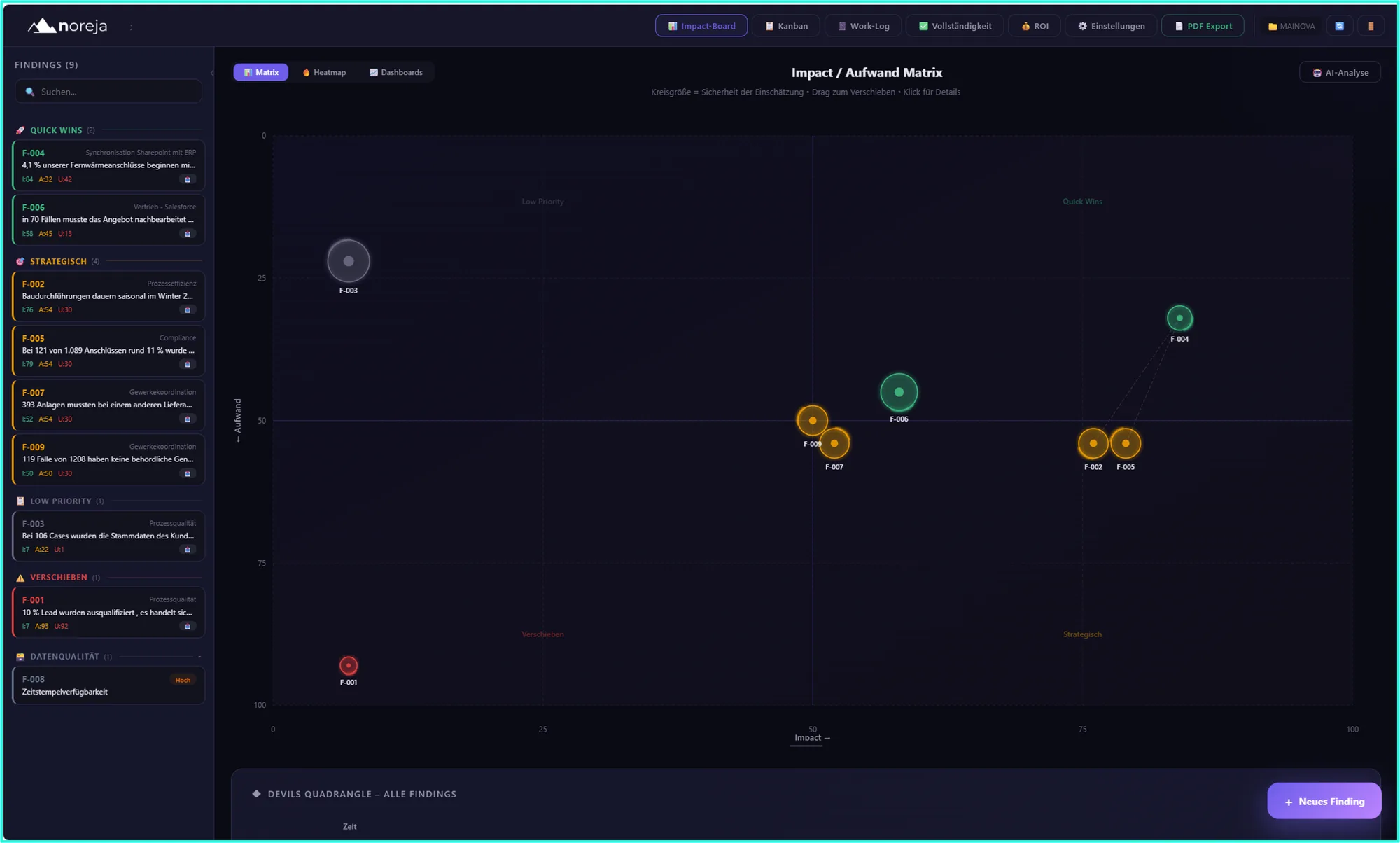
A finding does not improve a process yet. In the Impact Board, findings are rated by impact, implementation effort and uncertainty – process excellence and the business decide together which measure pays off economically and organisationally.

Placement in the Impact Board

Quick wins
High impact, low effort
Strategic
High impact, higher effort
Low priority
Low impact, low effort
Postpone
Low impact, high effort

Cost and impact categories

  • Waiting time
  • Wasted resources
  • SLA breach
  • Tied-up capital
  • Lost revenue
  • Compliance risk
  • Rework
Prioritised action plan
PriorityMeasureExpected benefit
1Bundle permit and construction-start managementShorten the biggest bottleneck of 77.8 days
2Link construction planning to a binding start-approval processReduce the 55.7 days after planning ends
3Standardise technical calculation and offer preparationShorten the 27 days in sales
4Record handover reports completely, in time and contentTransparency on documentation and handover delays
5Prepare construction acceptance earlyReduce the 27.8 days between construction end and start of acceptance
6Analyse invoice and supplier approvalsLess waiting after deliveries and fewer invoice corrections
7Make multiple orders transparentFewer avoidable procurement and coordination loops
Noreja Impact Board with an impact/effort matrix: district heating findings placed as quick wins, strategic, low priority and postpone
Impact/effort matrix: findings are prioritised by impact and implementation effort.

The loop: Insight → Action → Impact → Feedback

Improvement does not end with implementation. The question is not “Have we used AI now?” but “Has the process become faster, more stable or better in quality?”

  1. 1

    Insight

    Spot the error pattern, time series or missing prerequisite

  2. 2

    Action

    Derive, rate and prioritise a measure

  3. 3

    Impact

    Quantify the economic effect and implement

  4. 4

    Feedback

    Measure the effect against the process data again

Check after every measure

  • Has the lead time actually improved?
  • Has an error pattern become less frequent?
  • Has the affected process section stabilised?
  • Did the expected effect actually materialise?

Four principles behind the analysis

Keep granularity

Business objects and their relationships are not aggregated early into a flat event log.

Reduce complexity by business question

Analyses answer concrete process questions without losing the underlying information.

Causes, not just anomalies

Process behaviour is assessed against business and causal dependencies.

Operationalise insights

Findings become measures, are valued economically and then measured against the process data again.

Frequently asked questions about Lead-to-Activation

What is a Lead-to-Activation process?

Lead-to-Activation is the end-to-end process from a newly created lead to an active service at the customer. For a district heating connection it runs from lead qualification, technical calculation, offer and contract through the coordination of civil works, materials and house connection, construction and commissioning, to the handover report, billing and start of supply.

Why is a district heating connection hard to analyse with process mining?

Because after the order the process branches into several parallel strands – civil works or subcontracting, material procurement, house connection and commercial prerequisites – with different durations and cardinalities. One connection creates several purchase orders, deliveries and invoices, and bundled civil-works jobs create dependencies between cases. A single process map or a flat event log cannot represent that.

Which bottlenecks does the analysis reveal in the Lead-to-Activation process?

About 13% of offers go back for rework (154 of 1,208), construction takes about 20 days longer in winter, 121 connections start supply before the handover report is finalised, and construction start depends on several prerequisites – such as missing permits in 119 cases. The biggest time lever lies between civil-works permit and construction start, at 77.8 days.

How do you tell a process error from a data error?

In the event log both look the same. A late ERP timestamp can come from missing connectivity or later synchronisation in the field without the real process being late. Only a business assessment against objects, states and dependencies shows whether a process measure or a data measure is needed.

Are the figures from a real energy supplier?

No. The figures come from a synthetic demonstration dataset. They illustrate analysis paths and methodological relationships and are not production figures of any customer.

The full case description

Event knowledge graph, perspectives, error patterns, causal process logic, bundling and the path from finding to improvement initiative – step by step in the Noreja Help Center (in German).

Read the case in the Help Center

Want to analyse your own process? Talk to us.

Ready to Start

Understand your end-to-end process causally — talk to us

Join companies that are redefining growth and efficiency with intelligent process analysis.